Wednesday, November 30, 2011
People's Bank of China Drops RRR 50bps to 21%
The People's Bank of China announced a 50 basis point reduction in the required reserve ratios for deposit taking financial institutions, effective 5th December 2011. The new required reserve ratios will average 21.00% for large banks, and 19.00% for small banks. The move potentially marks a shift in policy focus to growth by the Chinese authorities, and follows the news last week that the required reserve ratio would be reduced for selected rural cooperative banks by 50 basis points to 16.00%, and also coincides with coordinated policy action by some of the key central banks to support the Eurozone.

Tuesday, November 29, 2011
Hungary Central Bank Lifts Rate 50bps to 6.50%

Monday, November 28, 2011
Bank of Israel Cuts Interest Rate 25bps to 2.75%
The Bank of Israel cut its benchmark interest by 25 basis points to 2.75% from 3.00%. The Bank said: "The decision to reduce the interest rate to 2.75 percent for December is consistent with the interest rate policy that is intended to entrench the inflation rate within the price stability target of 1–3 percent inflation a year over the next twelve months, and to support growth while maintaining financial stability. The path of the interest rate in the future depends on developments in the inflation environment, growth in Israel, the global economy, the monetary policies of major central banks, and developments in the exchange rate of the shekel."
Saturday, November 26, 2011
Monetary Policy Week in Review - 27 Nov 2011
The past week in monetary policy saw interest rate decisions announced by 6 central banks around the world. Of those changing rates, Georgia dropped -25bps to 7.00%, Egypt increased +100bps to 9.25%, and Colombia increased +25bps to 4.75%. Meanwhile those that held interest rates unchanged were Turkey at 5.75%, Nigeria at 12.00%, and Russia at 8.25%. Croatia also announced a cut to its Lombard rate (-275bps to 6.25%). Elsewhere, China made headlines when it was revealed that a number of rural cooperative banks were to have their required reserve ratios reversed by 50 basis points to 16.00%. Also, the ECB noted it had purchased EUR 8 billion last week, up from EUR 4.5 billion the previous week.


Friday, November 25, 2011
Colombia Central Bank Lifts Rate 25bps to 4.75%
The Central Bank of Colombia increased its monetary policy interest rate 25 basis points to 4.75% from 4.50%. The Bank said [translated]: "Given the central forecast described above, and the risks of financial imbalances, the Board considers it prudent to increase 25 basis points interest rate intervention and believes that this movement is achieved monetary stance which helps to maximize the growth of output and employment consistent with the achievement of future targets for inflation. This decision also includes the possibility of early detection of a substantial change in external conditions of the economy and to react quickly to it."
Russian Central Bank Holds Interest Rate at 8.25%

Croatian National Bank Cuts Lombard Rate 275bps to 6.25%
The Croatian National Bank decreased its Lombard lending rate by 275 basis points to 6.25% from 9.00% previously. Meanwhile the bank held its other interest rates unchanged. The Bank said: "In addition, the central bank is allowing commercial banks to use their reserve funds under certain conditions,"... "The central bank has to approve the usage of reserves and will charge an interest rate of the Lombard rate plus 1 percent for periods up to 3 months, and Lombard plus 2 percent for longer periods." according to Bloomberg.
Thursday, November 24, 2011
Central Bank of Nigeria Holds Rate at 12.00%

Egypt Central Bank Hikes Rate 100bps to 9.25%
The Central Bank of Egypt increased its overnight deposit rate by 100 basis points to 9.25% from 8.25%, and the overnight lending rate by 50 basis points to 10.25% and 7-day repo to 9.75%. The Bank said: "In its meeting held on November 24, 2011, the Monetary Policy Committee (MPC) decided to raise the overnight deposit rate by 100 bps to 9.25 percent while raising the overnight lending rate and the 7-day repo by 50 bps to 10.25 percent and 9.75 percent, respectively. The discount rate was also raised by 100 bps to 9.5 percent."
Wednesday, November 23, 2011
China Cuts RRR for Selected Rural Banks by 50bps to 16%
The People's Bank of China reduced the required reserve ratio for selected (20) rural cooperative banks by 50 basis points to 16.00% from 16.50% according to FT/Bloomberg. The move heralds a possible turn in policy settings in China, and follows previous comments from Chinese Premier, Wen Jiabao, that the Chinese government would "preemptively fine-tune policy at a suitable time and by an appropriate degree". The move also follows an apparent peak in inflation in China of an annual rate of 6.5% in July this year, dropping to 5.5% in October. The move also coincided with the release of the preliminary HSBC/Markit PMI which dropped to 48 in November, from 51 in October; also showing weakness in input and output prices, and new orders.
China's Evolving Reserve Requirements [BIS paper]

Turkish Central Bank Holds Repo Rate at 5.75%
 The Central Bank of the Republic of Turkey held its benchmark 1-week repo rate at 5.75%. The Bank said: "Recent data releases suggest that the rebalancing between the domestic and external demand is ongoing as envisaged. With the credit growth decelerating to more reasonable levels, the desired increase in private savings has already started to take place. Accordingly, the improvement in the current account balance is expected to become more significant in the final months of the year."
Tuesday, November 22, 2011
National Bank of Georgia Reduces Rate 25bps to 7.00%

Friday, November 18, 2011
Monetary Policy Week in Review - 19 Nov 2011
The past week in monetary policy saw just 6 central banks announcing interest rate decisions. Of those to change interest rates, Rwanda increased 50bps to 7.00%, while Belarus added 500bps to 40.00% as the country deals with hyperinflation. Those that held rates unchanged were: Japan 0-0.10%, Chile 5.25%, Sri Lanka 7.00%, and Latvia 3.50%. Elsewhere Argentina dropped dollar reserve requirements, and the World Gold Council announced record buying of gold by central banks.


National Bank of Rwanda Lifts Rate 50bps to 7.00%
The National Bank of Rwanda increased its key repo rate 50bps to 7.00% from 6.50% previously, with the interbank interest rate corridor changing to 4.50-8.50% and the discount rate now 10.50%. Bank Governor, Claver Gatete, said: "Rwanda's macroeconomic stability. The financial sector is sound and resilient to external shocks, the inflation remains moderate, the currency is stable and this has contributed to high economic growth expected to reach 8.8% by the end of the year. However, there still exist risks in the global economy that may affect Rwanda. This includes: the persistent debt crisis in the euro zone, the global high food and fuel prices and increasing regional inflationary pressures. This calls for preventive action to mitigate any negative impact on the Rwandan economy."
Central Bank of Latvia Holds Refinancing Rate at 3.50%
Latvijas Banka held its main monetary policy interest rate, the refinancing rate, unchanged at 3.50%, and held its other interest rates unchanged. The Bank said: "As the global prices of energy resources and food are stabilizing and assuming that the Government will refrain from raising any taxes, a substantial drop in inflation can be predicted for next year. Domestic demand is growing slowly and represents no risk of rising prices; moreover it is becoming likely that economic growth in Latvia will be slower next year as the demand in external markets drops because of the global debt crisis."
Belarus Central Bank Increases Rate 500bps to 40.00%

Central Bank of Sri Lanka Holds Rate at 7.00%
The Central Bank of Sri Lanka held its benchmark repurchase rate unchanged at 7.00%, and also kept the reverse repurchase rate at 8.50%, and the Statutory Reserve Ratio at 8%. The Bank said: "The outlook for Sri Lanka's economy remains positive with the economy continuing along the high growth trajectory", and "even though inflation and the inflation outlook remain benign, the Monetary Board is of the view that a change to the existing monetary policy stance is not warranted.
Thursday, November 17, 2011
Central Bank of Chile Keeps Rate at 5.25%
The Banco Central de Chile held its monetary policy interest rate unchanged at 5.25%. The Bank noted: "Domestically, output figures are evolving close to projections in the last Monetary Policy Report's baseline scenario, while domestic demand is somewhat stronger. Labor market conditions remain tight. Headline inflation has been somewhat higher than expected because of the incidence of fuels and foodstuffs. Core inflation figures remain contained. Inflation expectations are close to the target.
Bank of Japan Keeps Monetary Policy Settings Unchanged
The Bank of Japan held its interest rate steady at 0-0.10% and made no changes to its 55 trillion yen quantitative easing program. The Bank said: "Japan's economic activity has continued picking up, but at a more moderate pace mainly due to effects of a slowdown in overseas economies. As for domestic demand, business fixed investment has been increasing moderately and private consumption has remained firm. On the other hand, exports and production have continued to increase, due in part to the restocking of inventories abroad that had declined after the earthquake, but at a more moderate pace mainly reflecting the effects of the slowdown in overseas economies."
Monday, November 14, 2011
Central Bank of Argentina Drops Dollar Reserve Requirements
The Central Bank of Argentina cut the dollar reserve requirements to 20%, compared to previously where banks were required to keep all dollar savings not earmarked for trade finance at the central bank. The move is designed to assist financial institutions to meet their client demands, and follows a $645 million drop in deposits last week, according to Bloomberg. The Argentinian Government said [Google Translated]: the "new rule relaxes the minimum requirement of dollars that banks must deposit money in the entity. Thus facilitates the response of the entities to the eventual customer demand. They may have all the dollars that exceed 20% of the reserve and are not provided."
Saturday, November 12, 2011
Monetary Policy Week in Review - 13 Nov 2011
The past week in monetary policy saw interest rate decisions announced by 9 central banks around the world. Of those that changed interest rates (all dropping rates) were: Indonesia -50bps to 6.00%, Serbia -75bps to 10.00%, and Jamaica -50bps to 6.25%. Meanwhile those that held interest rates unchanged were: The UK 0.50%, South Africa 5.50%, South Korea 3.25%, Poland 4.50%, Malaysia 3.00%, and Peru 4.25%.


Bank of Jamaica Reduces Policy Rate by 50bps to 6.25%
The Bank of Jamaica reduced its policy rate by a cumulative 50 basis points to 6.25% in the September quarter. The Bank said in it's quarterly report: "The Bank's policy rate, the interest rate payable on 30-day certificates of deposit, was reduced on two occasions by a cumulative 50 basis points. Accordingly, at the end of September the policy rate was 6.25 per cent. The Bank's action was informed by an improved outlook for inflation for the rest of the fiscal year, a protracted period of stability in the exchange rate, adequate net international reserves and weak but improving domestic demand conditions."
Peru Central Bank Keeps Interest Rate at 4.25%
The Central Reserve Bank of Peru held its monetary policy reference rate unchanged at 4.25%. The Bank said: "This decision takes into account the lower growth being recorded by some components of expenditure, as well as the intensification of international financial risks. Should these trends continue, the Central Bank will change its monetary policy stance."
National Bank of Serbia Cuts Rate 75bps to 10.00%
The National Bank of Serbia cut its 2-week repo rate by 75 basis points to 10.00% from 10.75% previously. The Bank said: "Inflation continued down, in accordance with the NBS projection from the August Inflation Report. It is expected to decline further in the coming period. The key disinflationary factors will be weaker cost-push pressure on food prices, low aggregate demand and slower growth in administered prices. The process of disinflation will also be aided by the continued drop in inflation expectations."
Bank Negara Malaysia Holds Interest Rate at 3.00%
The Bank Negara Malaysia kept its Overnight Policy Rate (OPR) steady at 3.00%. The Bank said: "The domestic economy improved in the third quarter, due primarily to stronger domestic demand. Export performance also improved, reflecting firm regional demand and the normalisation of trade flows from supply chain disruptions. Looking ahead, the weaker external environment could, however, impact the overall growth prospects. Domestic demand will continue to be the anchor of growth, supported by private consumption and investment and reinforced by public sector spending and investment activity. Employment conditions are also expected to remain stable."
National Bank of Poland Holds Rate at 4.50%
The Narodowy Bank Polski's Monetary Policy Council kept the benchmark 7-day interest rate unchanged at 4.50%. The Bank said: "the medium term inflation will be curbed by somewhat lower domestic economic growth amidst fiscal tightening, including reduced public investment spending, and interest rate increases implemented in the first half of 2011, as well as the expected global economic slowdown. Such an assessment is also supported by the November projection of inflation and GDP. The impact of the situation in the global financial markets on zloty exchange rate continues to be an upside risk to domestic price developments"
Bank of Korea Keeps Repo Rate at 3.25%
The Bank of Korea maintained its 7-day repurchase rate unchanged at 3.25%. The Bank said: "domestic demand has faltered but exports have continued to grow strongly. The trend of improvement in employment conditions has been sustained, led by the private sector. The Committee anticipates that the domestic economy will keep up its long-term trend of growth going forward, but recognizes the situation to be one in which downside risks to growth remain high due to the impact of external risk factors."
Friday, November 11, 2011
South African Reserve Bank Holds Interest Rate at 5.50%
The South African Reserve Bank [SARB] held its monetary policy interest rate, the repo rate, unchanged at 5.50%. The Bank said: "The Committee assesses the risks to the inflation outlook to be on the upside mainly due to cost push pressures. The exchange rate is also seen to pose some upside risk to the outlook, while downside risks are seen to come from possible contagion effects from the European crisis and associated slow growth. The committee is aware of the dangers of a disorderly resolution of the crisis and the systemic implications for the global and domestic economy, and remains ready to act appropriately should the need arise."
Bank Indonesia Drops Rate 50bps to 6.00%
Indonesia's central bank, Bank Indonesia, dropped the BI reference rate 50 basis points to 6.00% from 6.50%. Bank Indonesia Governor, Darmin Nasution, said: "The decision to decrease BI Rate has been taken in line with the decreasing trend in inflation pressures and also as Bank Indonesia efforts to narrow the interest rate term structure. This decision is also intended to reduce the impacts of worsening global economic prospect on Indonesian economy. Production and consumption indicators in developed countries continue to show a slowing down while global financial markets remain volatile albeit there was a rebound."
Bank of England Holds Rate at 0.50%, APP at 275B

Friday, November 4, 2011
Monetary Policy Week in Review - 5 Nov 2011
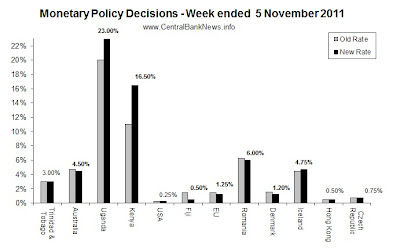
The past week in monetary policy saw 8 interest rate changes announced among the 12 central banks that met to review policy settings. Of those changing interest rates, those that increased rates were: Uganda +300bps to 23.00%, Kenya +550bps to 16.50%, and Iceland +25bps to 4.75%. Meanwhile those that cut rates were: Australia -25bps to 4.50%, Fiji -100bps to 0.50%, Europe -25bps to 1.25%, Romania -25bps to 6.00%, and Denmark -35bps to 1.20%. Those that held rates unchanged were: Trinidad & Tobago 3.00%, USA 0-0.25%, Hong Kong 0.50%, and the Czech Republic 0.75%.

Czech National Bank Maintains Rate at 0.75%
The Ceska Narodni Banka held the two-week repurchase rate at 0.75% as expected, and kept the discount rate unchanged at 0.25% and Lombard rate at 1.75%. The Bank said: "As regards the reasons for the decision, monetary-policy relevant inflation is slightly below the inflation target over the entire forecast horizon. Even headline inflation, which, as you know, is subject to an escape clause, and which, I assume you also know, will rise because of a VAT increase in 2012, will stay within the interval, i.e. it will remain below 3% and will, in our view, fall below the target in our opinion in early 2013. Consistent with the forecast is a slight decline in market interest rates and flat rates until late 2012/early 2013."
Hong Kong Monetary Authority Keeps Rate at 0.50%
The Hong Kong Monetary Authority kept its base interest rate unchanged at 0.50% following the decision of the US Federal Reserve to leave the fed funds rate unchanged at 0-0.25%. The HKMA also previously held its base interest rate unchanged at 0.50%, after the FOMC met in September this year and announced rates would stay low until mid 2013. The Hong Kong Monetary Authority generally tends to follow the monetary policy decisions of the US Federal Reserve's Federal Open Market Committee as the Hong Kong Dollar is fixed against the United States Dollar.
Iceland Central Bank Lifts Rate 25bps to 4.75%
Iceland's Sedlabanki increased its seven-day collateral lending rate by 25 basis points to 4.75% from 4.50% previously. The Bank said: "Recent data and the Central Bank forecast published today in the Monetary Bulletin confirm that Iceland's economic recovery continues, despite weakening global growth and increased uncertainty. Output is expected to grow slightly faster in 2011 and 2012 than was forecast in August, and inflation is projected to be somewhat lower in coming quarters as a result of a stronger króna and lower imported inflation."
Danmarks Nationalbank Cuts Rate 35bps to 1.20%
The Danmarks Nationalbank cut its key lending rate by 35 basis points to 1.20% from 1.55%. The Bank also cut the interest on certificates of deposit -35 basis points to 0.65%, the current account rate -35 basis points to 0.55%, and the discount rate -25 basis points to 1.00%. The Bank said in its press release: "The interest rate reduction is a consequence of the reduction by the European Central Bank of its rate on the main refinancing operations by 0.25 percentage point to 1.25 per cent. Furthermore Danmarks Nationalbank has purchased foreign exchange in the market."
Thursday, November 3, 2011
Romania Central Bank Cuts Rate 25bps to 6.00%
The Banca Nationala a Romaniei cut its key monetary policy interest rate by 25 basis points to 6.00% from 6.25%. The Bank said: "A significant improvement was recorded by the short-term inflation outlook, in line with NBR expectations regarding the end of the cycle of supply-side shock effects following the VAT rate hike that affected the economy and the favourable impact of the domestic agricultural production. However, the balance of medium‑term risks is still asymmetric, as they relate to external developments, investors’ risk aversion and capital flow volatility, as well as the fiscal policy stance and administered price adjustments."
European Central Bank Cuts Rate 25bps to 1.25%
The European Central Bank (ECB) cut its Main refinancing operations rate by 25 basis points to 1.25% from 1.50%. The Bank said "Owing to their unfavourable effects on financing conditions and confidence, the ongoing tensions in financial markets are likely to dampen the pace of economic growth in the euro area in the second half of this year and beyond. The economic outlook continues to be subject to particularly high uncertainty and intensified downside risks. Some of these risks have been materialising, which makes a significant downward revision to forecasts and projections for average real GDP growth in 2012 very likely. In such an environment, price, cost and wage pressures in the euro area should also moderate; today's decision takes this into account."
Wednesday, November 2, 2011
Reserve Bank of Fiji Cuts Rate 100bps to 0.50%
The Reserve Bank of Fiji cut its overnight policy rate by 100 basis points to 0.50% from 1.50% previously, in order to support economic growth in the context of an uncertain global outlook. Acting Chairman, Deo Saran, said: "The weaker outlook on global and domestic growth warrants such a move, particularly at this juncture where foreign reserves levels are comfortable and the outlook is stable, while inflation is expected to moderate over the coming months,"
US Federal Reserve Keeps Policy Settings Unchanged
The US Federal Open Market Committee (FOMC) held the fed funds rate unchanged at 0 to 0.25 percent, and made no other changes to its policy. The Fed said: "To support a stronger economic recovery and to help ensure that inflation, over time, is at levels consistent with the dual mandate, the Committee decided today to continue its program to extend the average maturity of its holdings of securities as announced in September. The Committee is maintaining its existing policies of reinvesting principal payments from its holdings of agency debt and agency mortgage-backed securities in agency mortgage-backed securities and of rolling over maturing Treasury securities at auction."
Tuesday, November 1, 2011
Central Bank of Kenya Hikes rate 550bps to 16.50%
The Central Bank of Kenya upped its benchmark lending rate by 550 basis points to 16.50% from 11.00% previously, and raised the Cash Reserve Ratio 50 basis points to 5.25%. The central bank Governor, Njuguna Ndung'u, said: "Inflation continued to rise while exchange rate volatility persisted in October 2011. Consistent with the monetary policy stance taken by the last MPC meeting, there is therefore a need for further tightening of monetary policy to tame these inflationary pressures and stabilize the exchange rate."
Bank of Uganda Lifts Rate 300bps to 23.00%
The Bank of Uganda raised its new monetary policy interest rate (the central bank rate [CBR]) by 300 basis points to 23.00% from 20.00% previously. The Bank also raised the rediscount rate to 28.00% and the Bank Rate to 29.00%, by the same margin. Bank of Uganda Governor, Emmanuel Tumusiime-Mutebile, said: "The Bank of Uganda expects that inflation will peak in the coming months and will then decline during 2012, with core inflation reaching single digit levels at about the end of that year. Core inflation is projected to fall further to the Bank of Uganda's policy target of 5 percent in the medium term. However, should upside risks to inflation increase, monetary policy will need to be tightened further."
Subscribe to:
Comments (Atom)